The Twelfth Century I : Irish Society
Summary.
Describes Irish society in the
Twelfth Century and in
particular Church reform
*********************************************************************************************
Church Affairs
Rathbreasail
Saint Malachy
Visit to Rome
Synod of Kells
Implementing the Reforms
Military
Matters
The Economy
Irish
Society
Art, Architecture and Learning
*************************************************************
Importance of the Twelfth Century
For the development of Irish Society
this century is probably the most important of all. More and greater changes
were introduced in this century than in any other. Religious and political life
was to a large extent transformed. So too was art and architecture while the
new methods of the schools and universities poured in. There had been great
changes, imperceptible at first, when Christianity and writing was introduced.
The same was true when the Vikings brought a proper trading economy with towns,
markets and coinage. But there was nothing like the changes in the twelfth
century in their swiftness and scope. Ireland
was suddenly dragged into the modern world. Whole new systems of administration
and law were introduced, which if they had been embraced by the Gaelic chiefs,
as they had been in Scotland, could have transformed Ireland
into a prosperous, peaceful, and united kingdom.
Ireland’s
tragedy is not that the Norman’s came, but that the Gaelic chiefs, for selfish personal gain, largely
rejected what the Normans brought.
(This chapter on the social aspects of Irish society is placed
before the political aspects reversing the plan in the rest of the book. The
reason is that the political events before and after the coming of the Normans
run together so that it was preferable to keep them in consecutive chapters.
Also, the political changes are best understood, if the sweeping social changes
are understood first.)
Church Affairs
At the beginning of the twelfth century the
first great wave of innovation arrived in Ireland.
This was the wave of Church reform commonly called the Hildebrandine reform
reached Ireland. In England in 1107 Henry I and Anselm of Canterbury reached a working
agreement over investiture similar to that reached later in 1122 between Pope
Callixtus II and the Emperor Henry V, a system of joint investiture which
ensured that king or emperor had not exclusive authority over ecclesiastical
lands. This system worked in England
because neither Henry I nor St Anselm wished to push matters too far. But it
was unresolved at the time of Henry II and St Thomas a Becket, which led to the
murder of the latter. In 1098 Citeaux had been founded and in 1128 Anselm’s
chief assistant, William Giffard of Winchester
established the first Cistercian monastery in England
in 1128 at Waverley in Surrey. In 1104 the hierarchy of Scandinavia was properly established with the appointment of an archbishop of
Lund in Denmark.
(An archbishopric was formed in Norway
about 1150 under the direction of the legate, Cardinal Nicholas Breakspear.)
One of the most surprising things was that in
five hundred years nobody ever got round to organising the hierarchy in Ireland,
nor was even a legate sent from Rome. Then several legates were sent in the twelfth century. If the
theory proposed in the book is correct that the evangelisation of Ireland
came from Britain, the bishops in Ireland
were subject to some British bishops, but no attempt was made to assert
jurisdiction before Lanfranc. Nor was there any metropolitan bishop in Ireland,
despite the effort of the church of Armagh to assert primacy. (This was also the case in Wales and
Scotland.) Nor does there seem to have been any attempt,
except perhaps in the fifth century, to govern by means of councils.
Irish dioceses were largely autocephalous. This was not peculiar to Ireland
for it seems to have existed for longer or shorter periods wherever
Christianity spread beyond the limits of the Empire which had a strict civil
subordination of cities and towns. But in Germany
the situation had been regularised as early as the time of St Boniface, and
regular hierarchies established perhaps less than fifty years after the first
bishops were installed there.
Every religious reform of religious
institutions must begin with reform of the temporalities. Resistance to reform
usually comes from those who will lose out financially. It did not matter if
control of Church property was in the hands of great Roman families, of the
German emperor, or the erenaghs of monasteries and dioceses in Ireland.
There is an interesting account of the visitation of Flaibeartach O’Brolcain
(Flaherty O’Brollaghan) the abbot of Derry who died in 1175. He was also chief of the
Columban monasteries in Ireland, Derry having taken over the leadership from Kells. On his visitation in
1150 he received a gold ring, and a horse from Murtagh MacLoughlin as
over-chief and twenty cows as chief of Aileach. From each lord or sub-chief to
the number of fifty he received a horse; from every two biatachs (free farmers) one cow; from every three saertachs (free tenants) a cow; from
every four diomhains (people of
lesser means) a cow. The tribute due from each tuath was stated precisely. More oddly he visited the MacDonlevy
lands in Ui Eachach Choba among the Ulaid where he got a horse from each
chief and a sheep from each hearth, besides tribute from MacDonlevy and his
wife. He received the same from Dal
Cairbre that seems to be the same as Dal
Riata. Flaherty never was made a bishop, yet the dues to the coarb of St.
Columcille seem to have exceeded those to the coarb of St. Patrick in the see
of Armagh. When the diocese of Derry was formed it became and remained until the disestablishment of the
Church in 1869 the richest see in Ireland.
Apparently the first
duty of a new bishop, as of a new chief, at that time, after receiving the
submission of the erenagh, was to try to collect the occasional dues to his
see. So the first duty of Celsus after he was made bishop of Armagh in 1105 was to visit
every church in Ulster and Munster which recognised the authority of Armagh and collect the tribute
in cows, sheep, and silver from each tuath.
He made this visitation on various occasions collecting the tribute on each. He
was then able to replace the roof on the stone church or cathedral in Armagh that had been roofless
for 130 years. The bishop (ard easbog)
of Armagh Gelasius in 1138 collected the tribute in Munster, obtaining
the full tribute. In 1140 he visited the churches in Connaught and received a
‘liberal tribute’, Turlough O’Connor recognising the position of Armagh. Also in 1140 he got
twenty cows from Murtagh MacLoughlin, a horse from every sub-chief, and a cow
from every biatach if the annals
report accurately. In 1158 he made a circuit of Ui Eachach Choba (Iveagh) and
Dal Cairbre (Dal Riata?). From the MacDonlevy chief of Iveagh he obtained a
horse, five cows, and a payment in coin, an ounce of gold from the king’s wife,
a horse from each chief, and a sheep from each hearth. This tribute was
assessed on the tuatha and could not
be made without the full co-operation of the chief of the clan. It is obvious
that only Cenel Eogain, Ui Eachach Choba and another territory
collected the tribute for him.
At this particular
time, the evils of the practice of an hereditary
family of erenaghs holding all the lands of the various churches could be
regarded as similar to evils of investiture. In both cases, a bishop would not
be given the temporalities of his see if he displeased the lay family involved.
With regard to simony, the ecclesiastical office would have been purchased from
the same landowner, not from a senior ecclesiastic. Again, simony would have
been hard to avoid because every applicant would have had to present a
gift to the landowners before his application would have been even received.
Irish bishoprics
seem to have been poorly endowed with land. The bishop had by the twelfth
century the comparatively low status of the chief of a tuath though when conferred it had been a high one. The land
attached to his church and residence may not have exceeded the extent of a
single townland. A tribute consisting to a horse from the chief of the tuath, a cow or half a cow from the
chief farmers, and a sheep or share in a cow from lesser folk was probably paid
only once. The revenues from lending cattle to the clients in his tuath may or may not have been available
to him, for more than likely the chief would reserve this to himself. The
church lands could also be used by the chief for grazing his cattle on, and the
bishop would have to pay his tribute to the chief unless he was classified as a
non-tribute payer. The income of a small independent bishopric like Duleek
could have been of the order of fifty cows a year for the support of the bishop
and his clerics. One of the duties of the reformers was to try to increase the
revenues of the bishops, and to get them out of lay control, to enable them to
maintain an adequate household of clerics of learning and experience.
Commencement of Reform
Reform
of the Church commenced first in 1101 in Munster where the power of the O’Briens had reached its
peak. (It is reasonable to assume that the
Viking diocese of Dublin that considered itself outside the Irish system had already
introduced Anselm’s reforms. Though Anselm had to rebuke Samuel O’Haingli,
bishop of Dublin from 1096 to 1121, for having an archbishop’s cross carried
before him although he had not sought the pallium
from Rome.) Murtagh O’Brien was a warlike man and unlikely reformer and one
might be forgiven for suspecting that his chief interest was to get Killaloe
made the archiepiscopal see. The reformers knew they could not proceed without
strong backing from the civil power to enforce any reforming canons or
statutes, so we may suppose that they acquiesced in that ambition, especially
given the fact that the church in Armagh was the chief example of the abuses to
be reformed. Nor could it be foreseen that the period of O’Brien dominance in Ireland
was coming to an end. In any case Murtagh O’Brien in 1098 invited a bishop in
one of the tiny dioceses in Meath (probably Clonard), Maelmuire O’Doonan, to be
his adviser, and Paschal II (1099-1118) was induced to make him his legate.
There were eight separate dioceses in county
Meath.
Papal legates were given delegated powers to
act for the Pope in designated areas. There does not appear to have been any
restriction regarding time placed on these legatine commissions other than the
lifespan of the Pope. (There were eight Popes in the first half of the twelfth
century.) The purpose of granting legatine powers to a particular Irish bishop
could have been restricted to convoking synods and presiding over them thus
supplying the central power lacking in Ireland
at the time when there was no archbishop, or even no king, to convoke a synod.
Almost certainly, the reason why Paschal was induced to send a legate was his
wish to secure an agreement with the de
facto king of Ireland, Murtagh O’Brien regarding investiture, for this was
the great aim of his pontificate.
O’Doonan in 1101
summoned a synod at Cashel, apparently the first of any kind held in Ireland
for at least three hundred years It was doubtless
intended to be a national synod yet was only attended by the clergy and
nobility of Munster and Leinster. Though intended to be a Hildebrandine reform laymen were still
summoned and participated. If they had not been the decrees would have been ignored. The decrees were typical of the time. Simony
was condemned and ecclesiastical property exempted from secular tribute. This presumably
was the tribute to be paid to each new chief; failure to pay the tribute was a
signal of revolt, and was very common. It was normally followed by forcible
collection if the new chief had gathered sufficient support. The age old
practice of coshering, the custom of the chief coming to stay in the rath of a
dependent along with all his household was not
apparently condemned or discontinued. Rather the custom seems to have been
encouraged of endowing dioceses and monasteries of new foundation with exempt
lands taken from their defeated opponents. Endowing monasteries with lands
taken from their victims seems not to have been new, but for the future such
lands would not be subject to forcible coshering. Nobles of course still came
to monasteries and expected to be fed but rather from hospitality of the bishop
or the abbot not of right. The third point was to restrict the holding of
ecclesiastical benefices to clerics. This again was largely a statement of
principle than a major change in practice. But it meant for example that if a
layman was appointed to any benefice producing revenue he was expected to seek
ordination to the appropriate grade of the clergy. An abbot would have to be
tonsured at the very least, and a parish priest or bishop ordained. The system
of lay families of erenagh, presumably descended from some ordained deacon, who
had complete control of the temporalities of the diocese, was to be phased out.
The fourth canon tried to deal with the problem of overlapping jurisdictions.
This seems to have been aimed at overlapping episcopal and monastic
jurisdictions for the dioceses themselves probably did not even touch each
other let alone overlap. Concubinage of the clergy was forbidden, though
whether this excluded properly married clergy is not clear. It probably did
not. The law of sanctuary was reformed, and the clergy were declared exempt
from secular courts. Included in this canon were poets, though in any case the
canon was more a statement of principle than a change in actual practice. It
was also in line with developing canon law in western
Europe, where finally all those who could write could claim ‘benefit of clergy’
and demand trial before an ecclesiastical court, Finally, some precision was
introduced into the laws of matrimony (Dolley 7ff). The state of the marriage
contract at the time is outlined by D’Alton. The chief point was that
betrothals were regarded as equivalent to marriage, but did allow revocation.
Brehon law allowed divorce. Though the intention was good regarding temporalities,
the matter was not finally settled until the disestablishment of the Church in
1869.
The reforms
proposed were what we regard as typically Hildebrandine, but it does not follow
that the reformers themselves at the time had a clear idea either regarding
what was an unwarrantable abuse or how they envisaged the future Church. What
was clerical dress supposed to be like? Could brightly coloured garments be
worn? Could a priest follow a trade, hunt, or go to war? Could he drink alcohol
in a public place? Points like these were to be decided and incorporated in the
statutes of later synods and in Roman decrees. The general idea, nevertheless,
behind the Hildebrandine reforms was that religious and secular, i.e. warlike affairs, had become too closely intertwined and the result
was not good for simple morality like practising the Ten Commandments. The
envisaged solution was that secular and clerical roles should be more clearly
defined and separated to some extent. To us it might seem that the reformers
were taking a very cautious approach, but they themselves probably considered
the approach bold and radical. The new Orders, especially of canons, were to
supply many of the answers. Gilbert of Limerick wrote and published two works
on the subject, especially with regard to the rite of the mass (D’Alton).
Apparently, the rite varied very considerably from church to church.
The great omission
is any canon on the burning topic of the day regarding which Anselm and William
Giffard of Winchester were forced into exile in 1102, namely investiture. We may assume
that the practice of the Irish chiefs was little different from that of the
feudal monarchs, but they were not making feudal service for church lands a
condition for tenure, at least not openly. That any abbot or bishop would
refuse such services to his chief would be unthinkable, but so long as it was
not put down in writing it was possible to pretend it did not exist. No Irish
chief had any intention of allowing a person on whom he could not rely to become
a bishop or abbot if he could help it or prevent it. Nor would he be remiss in
securing a valuable office for one of his friends. But so long as he did not
make election to the office conditional on swearing feudal and military service
there was no need to tackle the question openly. A start had been made.
One famous act of
Murtagh O’Brien at this synod was to endow the diocese of Cashel from seized or
abandoned Eoganacht lands. Why he did
this is not clear, as the more natural and customary thing would have been to
give the lands to his own followers. It may very well have been that he hoped
that there would be a single archbishop in Ireland
when a proper hierarchy was provided by the Pope, and that that archbishopric
would be at Cashel. There is no reason to imagine that Murtagh had any scruple
about appropriating Eoganacht lands.
In 1105 two men
were consecrated bishop who were to push forward the reform, Celsus (Cellach)
bishop of Armagh as mentioned above, and Gilbert, or Gilla Espaic, bishop of the
new Norse diocese of Limerick, this being the third Norse town to get its own
bishop. Gilbert had apparently studied abroad and had met Anselm of Canterbury
but did not seek consecration from him. Nevertheless Anselm congratulated him
and urged him to promote reform especially in the appointment of bishops and
their consecration by three bishops in the proper place. Anselm also urged, and
Gilbert tried to comply, that the Roman or Sarum use should be adopted for the
celebration of mass and the sacraments in place of the various Irish rites
derived from the ancient Gaulish rite (D’Alton). The latter had long since
fallen into disuse in France and England.
In Armagh Celsus
came from a local family (Clann Sinaich
of the Oirgialla) who had provided
bishops to the see of Armagh for fifteen generations whether they were clerics
or not, according to St Bernard. More recent scholarship restricts this to nine
successive bishops and some earlier ones. There is little doubt that these were
married men (married only once according to St Paul’s
prescription 1 Timothy 3.2) or indeed laymen who employed
an assistant bishop to discharge the duties of a bishop. He was a close
relative of the late bishop and probably underage, but at least he sought
ordination and proper consecration as a bishop. (St Malachy who followed him
was the son of the principal teacher of theology in Armagh, a married man.) He
immediately began by asserting the claims of Armagh and took tribute from
every church in Ulster and Munster. Whatever had been Murtagh O’Brien’s intentions, Celsus first made
sure that the claims of his see, which were largely financial, were conceded.
He used part of the money to replace the roof on the stone church in Armagh that had remained a ruin
since it was burned by the Norse a hundred and thirty years before. He also
made sure that he was the person to adjudicate in secular disputes. The
reputation of Celsus as a reformer (and a saint) seems to be based largely on
the fact that he was St Malachy’s patron, who ordained him, entrusted him with
much of the administration of the diocese during his own frequent absences, and
tried to get him established as a bishop, first in Down
and later in Armagh. His own activities were largely on the political scene where
churchmen were always in demand as intermediaries
It is just possible
that the legatine powers granted to Maelmuire O’Doonan or Gilbert of Limerick
included powers to establish one or more archbishoprics and to confirm the
newly elected archbishops, i.e. grant them the pallium. But this is extremely unlikely. For, as everybody knew, Ireland
had a hierarchy. From the point of view of Rome, the first
points to be established were whether Canterbury, as the
chief metropolitan see in the British Isles, had, or had traditionally exercised metropolitan jurisdiction in Ireland.
The other point would have been to determine if any bishopric in Ireland
had been properly constituted a metropolitan authority and had exercised that
authority in the normal way. If these points were both established in the
negative, then an Irish synod should petition the Pope that one or more
metropolitan sees should be established, and the pallia sent to them. This was pointed out later to Malachy when he
went to Rome to claim the pallium. The
pallium was a narrow neckband or band
around the shoulders with narrow pendants before and behind. By the middle of
the ninth century all archbishops were required to petition the Pope for the pallium, forwarding at the same time a
profession of the faith. By the time of Paschal II an oath of allegiance to the
Pope was required instead. By this date too the metropolitans were not allowed
to exercise the rights of archbishops before they received it (Catholic Encyclopaedia, Pallium).
[Top]
Rathbreasail
In 1111 at a place
called Rathbreasail near Thurles, county
Tipperary in
north Munster, there was held, at Murtagh’s instigation, what was probably the
first proper synod of the Irish bishops since the time of Saint Patrick. (This
excludes the synods convoked for the sole purpose of deciding the dates of
Easter.) It would seem that every bishop in Ireland
to the number of fifty attended and they had good reason to do so. If there
were about 100 tuatha in Ireland, 50 would have been bishoprics, and fifty merely parishes. However it
is reasonable to assume that many chiefs rushed to get a bishop in their tuath if there was the slightest
tradition that there had ever been a bishop in it. The normal number of bishops
could have been much lower. They were doubtless aware that the number of
bishoprics would be cut in half and the system rationalised. Nobody would want
to be among those whose sees were extinguished. There was also the fact that a tuath which was merely a parish would
have to contribute to the support of the church in a different tuath where the bishop resided. Even
among the greater dioceses there was the question of precedence. About three
hundred of the lower clergy are also said to have attended, though the number
of students and laymen given as three thousand may have been an exaggeration.
(Earlier I estimated that the total number of priests in Ireland
at any time was about 160. An attendance of 300 priests would seem to indicate
the total number of priests in Ireland
at about 600, which seems extremely unlikely. If 300 clerics are meant, meaning
those to had at least received the clerical tonsure, the figure is more
likely.) We can assume that Murtagh took responsibility for housing and feeding
them no doubt by means of forced labour and forced exactions of food. Murtagh’s
protege, Gilbert of Limerick, was made papal legate and presided, taking precedence
over Armagh.
Celsus of Armagh
and Malchus O’Hanvery of Cashel were appointed as ‘archbishops’ at
Rathbreasail. (Malchus O’Hanvery, first bishop of the Viking see in
Waterford was
translated from Waterford to Cashel in 1111.) Bishop O’Doonan’s commission could have
extended until the death of Paschal II in 1118, and likewise the commission of
his successor Gilbert of Limerick, likewise appointed by Paschal. Or they could
have been given the commission for a particular occasion, namely the holding of
a synod to establish and confirm a hierarchy. In this supposition the question
of applying to Rome for the pallium,
which signified both the papal acceptance of the newly elected archbishop, and
his empowerment to proceed with his duties as archbishop, would not have arisen
before the death of Celsus of Armagh in 1129, but more realistically after the
accession of Malachy in 1134 or the election of his successor Gelasius in
1137. The second archbishop of Cashel
was elected in 1131 but it is not obvious why he did not seek the pallium. The O’Briens may still have
been trying to get Killaloe recognised as the metropolitan see. However, the
likelihood is that the establishment of a hierarchy was not within the remit of
either legate. Accordingly Celsus and Malchus would only have been designated
archbishops.
Ireland,
like Wales and Scotland, seems to have presented a problem never envisaged in canon law.
Bishops had been consecrated haphazardly in disjoined areas of land, but no
hierarchy ever seems to have been established. Irish dioceses were in fact
autocephalous, i.e. independent of each other and not subject to each other.
This too was true in Scotland and Wales despite the recurring efforts of Canterbury to
assert its authority. (The claim of Canterbury would
have been stronger in Wales that was once part of Roman Britannia than in either Scotland
or Ireland.) There was however another problem in Ireland,
which was not found in the comparable regions of Wales and
Scotland, and that was the excessive numbers of
bishops. When hierarchies were being established within the Roman Empire it mattered little
if every town had its own bishop, so long as the largest town in the region had
a metropolitan bishop with his learned counsellors to supervise them. When
missionaries went into Germany, at first a handful of large bishoprics were established, and as
their numbers grew, some of them were given metropolitan status.
But in Ireland,
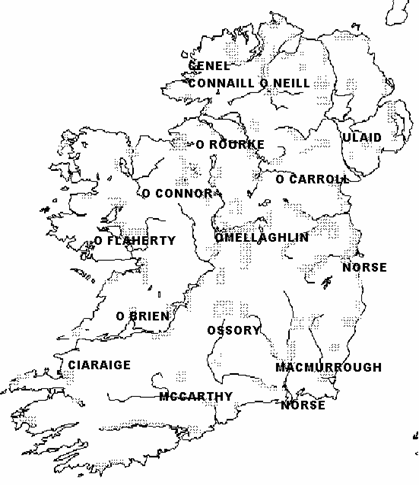
the only long-established and universally recognised political units were the tuatha that covered at most an area of
ten miles by ten. Chiefs like those of the Ui
Neill and the Eoganacht had
enforced their authority over widely separated areas, and could not agree among
themselves regarding who controlled what. Their areas of control were neither
fixed nor contiguous. If any tuath wanted
a bishop they just had one consecrated. The only rule was that there could not
be two bishops in one tuath. The
number of these bishops could have reached fifty, but as noted above this
figure was probably inflated just before the synod of Rathbreasail. In course
of time, some dioceses claimed precedence, and hence tribute, on the grounds of
antiquity, and Armagh seems to have succeeded in persuading a lot of people that its
diocese had been founded by St Patrick, and that he had established it as the
premier see. The only grounds for this claim seems to
be the possession of two documents written by one Bishop Patrick who never
mentions Armagh or mentions the name of his own diocese. On the other hand, abbots
of monasteries could make similar claims, and any appeals in disputes were as
likely to be referred to the abbot of a famous monastery as to the bishop of a
famous diocese. The standing of both monasteries and dioceses was intimately
connected with the standing of the local rulers.
In the absence of
large cities or towns, to form a diocese three conditions seem to have been
decided on at Rathbreasail. Each see should occupy the territory of large ruiri or mesne chief, (not the tuath of a ri)
and it should be centred on a large cathedral church or monastery within that
territory, and that the monastery or church had traditionally been the centre
of a diocese. An archdiocese would be that nominated by the ri ruirech or provincial king, the O’Briens and O’Neills being
accorded this status.
As is usual in such matters we can assume that
the leading reforming bishops had presented their list to Murtagh O’Brien
before hand, and that political realities dominated their choices. There were
to be two archbishoprics, or metropolitan sees. Neither Armagh nor Cashel was given the
exclusive title. Celsus of Armagh was to be one archbishop, and Malchus
O’Hanvery, bishop of Waterford was to be archbishop of Cashel. Dolley sounds a warning about
accepting at face value the seventeenth century copy of the decrees. (What is
known about the synod was recorded in the lost Book of Clonenagh, cited by Geoffrey Keating in1629, Moody, Martin,
and Byrne p.101.) In particular we can very much doubt whether the process of
establishing a formal hierarchy with two provinces was ever completed. It is
more probable that Gelasius (Gilla mac Liac mac Diarmata mac Rory) in 1152 and
not Celsus was the first archbishop of Armagh, and the first to receive the pallium.
In this view, Celsus would have retained a more tradition title of ard easbog or high bishop in recognising
the primacy of Armagh. D’Alton notes that the two archbishops had honour and dignity but
not jurisdiction (190 footnote).
There were to be
two provinces headed by the archbishops of Armagh and Cashel. To the Armagh province were assigned sees in Ulster,
Meath and Connaught, and to the province of Cashel, sees in Munster and Leinster. This recognised that Donal MacLoughlin would never accept a single
archbishop controlled by Murtagh O’Brien.
In Ulster (including Meath, i.e. the lands of
the Ui Neill) the Cenel Conaill got a diocese centred on Raphoe, the Ulaid got two dioceses, one centred on
Connor in Antrim the territory of the Dal
nAraide, the other centred on Bangor (later at Down) in the territory of
the Dal Fiatach. The O’Rourkes of
Breifne got a diocese centred on the monastery of Kells. The O’Carrolls in
Oriel got Clogher centred on the monastery and cathedral church of that name.
The rest of the lands of the Oirgialla
were allotted to the cathedral of Armagh, though in fact much of the Oirgialla
lands were in the hands of the Ui Neill.
This was the archdiocese allotted to the Ui
Neill. There remained a problematic bit. Celsus had obviously no intention
of conceding any rights to the monastery of Derry, the great rival of Armagh in the north. The hinterland of Derry in Inishowen at this time was passing into the hands of the Cenel Conaill (O’Dohertys) as the
O’Neills, now established at Tullaghogue, were unable to hold it. Nor had the
O’Cahans yet established themselves as the dominant
power in the area. In any case they were dependants of MacLoughlin who does not
appear to have attended the synod. So the last place was assigned to Ardstraw
among the almost defunct Cianachta of Ui Fiachrach Ardsratha but with the
principal church at Maghera in newly acquired Ui Neill lands. The
abbots of Derry later were able successfully to claim the see, and it remains the
diocese of Derry to this day. In Meath the old division between Sil nAedo Slaine (Duleek) and Clann
Colmain (Clonard) was maintained. At a local synod a few months later Meath
was divided differently with Clonmacnoise being given western Meath, and
Clonard being compensated with the territory of
Sil nAedo Slaine, Duleek. Duleek apparently was to be compensated with the petty
clans in Louth ‘ who marched with the Oirgialla’, but in the event these
lands, in the heyday of the O’Carrolls, were given to Clogher. They afterwards
reverted to Armagh. (In 1174 the bishop of Clonard, under Hugh de Lacy, absorbed the
sees of Duleek, Trim, Ardbraccan, Kells and Slane, presumably by having the
temporalities of those sees transferred to his own. Meath became one of the
richest dioceses.) In Connaught, Elphin represented the territory of the
O’Connors, Ardagh the lands of the Conmaicne
vassals of the Ui Briuin Breifne,
Cong the lands of the Ui Briuin Seola,
Killala the lands of the Ui Fiachrach
Muaide, Tuam was also in lands of the Ui
Briuin Seola. Clonfert represented the territory of the Ui Maine. Dublin was not
dealt with and the bishop of that see Samuel O’Haingli probably did not attend
the synod
In Leinster, ignoring Dublin,
sees were to be established at Ferns (Ui
Chennselaig), Ossory, and Glendalough (O’Tooles), while the Ui Dunlainge were given two sees, one at
Kildare and one at Leighlin (Carlow). Clearly it was impossible to ignore the
ancient monasteries of Kildare and Glendalough, for otherwise there was no need
for them to be separates sees. In the case of Glendalough it was assumed that
it would incorporate Dublin, but the reverse occurred.
In
Munster, for no
very obvious reason, it was decided to make the archiepiscopal see at Cashel
the former centre of the displaced Eoganacht
that Murtagh O’Brien had endowed with confiscated Eoganacht lands. There was to be a see including Waterford and the
monastery of Lismore (Deise). The
MacCarthys were given a see based on the monastery of Cork, the Ciaraige given a see based on the
monastery of Ardfert. The ancient claims of Emly could not be ignored. The
O’Briens got two sees, one based on their old stronghold at Killaloe, and the
other on their new residence in Limerick. To Norse Limerick was added the old territories of the Ui Fidgente. There was a decidedly
antiquarian slant to this division. As no actual bishops were removed from
office, the idea was that successors would be appointed only in the nominated
sees.
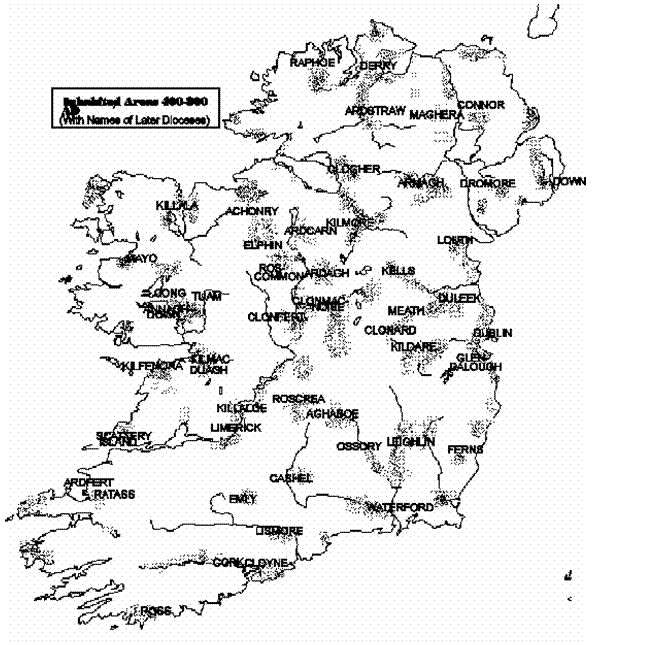
It is noteworthy
that the boundaries of the dioceses are not exactly delineated. No maps of Ireland
existed then or for centuries later. Parts of Ireland
were normally but not exclusively named after the ruling family and the
boundaries of the diocese were the boundaries of the influence of the ruling
families. It is fairly safe to assume
that at least two thirds of Ireland
was still scarcely inhabited, and that by the year 1100 the process of draining
marshes and clearing woods which had commenced in other parts of Europe a hundred years earlier
had scarcely begun in Ireland. The various chiefdoms would still have been separated by wide
bands of wasteland and woods. Indeed some definitive boundaries in the middle
of bogs were not properly established until the middle nineteenth century. The
limits of each diocese were indicated by four reference points (Moody, Martin,
and Byrne eds. IX 101 and map.)
The tuatha that lost their bishop or never
had a bishop would become parishes. The history of Irish parishes still remains obscure, and we have no idea how many parishes
were established when Christianity was first adopted, how many subject clans
were served by monasteries or hermits, or how many survived the Viking period.
In any case the non-monastic parochial clergy had disappeared. In the taxation
returns in the early fourteenth century only thirteen parishes were recorded
for the parts of Clogher lying in present day Monaghan and Louth. The parish of
Clogher was later returned as comprising 72,147 statute acres which if it were
perfectly square would measure ten miles by ten (M’Kenna 140). The average size
of parish in Monaghan and south Armagh was about 20,000 acres or about five miles by six. (Gillespie and O’Sullivan eds. 13.) In adjacent
county
Louth where
the manorial system of agriculture had been introduced under the
Normans, parishes
became much smaller at around 2,300 acres (ibid.)
In the nineteenth century, after the rationalisation
of Catholic parishes that followed the Reformation, there were around 1,000
parishes in Ireland averaging around 20,000 acres (Keenan).
The establishment
and endowment of parishes everywhere was the responsibility of the local bishop
with the consent of the local lord who would either contribute the glebe lands
or endorse the benefaction.
There can be little
doubt that the revenues of the parishes and deaneries went to the relatives of
the chiefs, and that scarcely any provision was made for the education and
support of parochial vicars, or the poor and sick. As elsewhere in Europe, the instruction of the
poor was left to monks and members of the new religious Orders. The proper
organisation of parishes would have to wait the post-Reformation period. For
example in 1306, for some obscure reason, the revenues of the deanery of
Donaghmoyne in Monaghan (tuath of the
‘Crickmugdorn’) belonged to the monastery of St
Mochta in Louth. They were collected by the erenagh of the monastery, and a
vicar discharged the duties of the parish, and presumably also of the deanery.
The principal landowner in the parish in 1640 was Col. Bryan MacMahon, Member
of Parliament, who had 15,766 acres (M’Kenna 351-2). Church lands in the parish
in the seventeenth century amounted to 809 acres in 10 lots according to one
record, or 420 acres in 7 lots according to another. (This would have been the
equivalent of 8 or 10 townlands, or farms of a boaire.)
As Dolley observes
(16), Ireland now had a recognisable hierarchy, written down on parchment at
least, and canon law such as it was could be applied. Gratian did not finish
his collection of canons and decrees until 1140 but the relevant materials were
extant and known to a greater or lesser degree by local learned clerics. We are
lacking in information about how the reforms were implemented. There is nothing
at all like the flood of printed information we have about how the reforms of
the Second Vatican Council were implemented in the various dioceses. Indeed,
the bulk of what we know about events over the next thirty years comes from a single
source, St. Bernard’s Life of St Malachy, which reflects one person’s
point of view. The Annals from time
to time supply curious bits of information such as struck the fancy of the
chronicler, for example the tribute the abbot of Derry collected.
Several questions
remain to be answered. Was Malachy in 1139 the first to seek the pallium and if so why was this? Why,
when Malachy arrived in Rome to seek the pallium was
he sent home, and empowered to convoke a synod for the purpose of petitioning
the Holy See to erect metropolitan sees? What did Celsus of Armagh, and Malchus
O’Hanvery and Gilbert of Limerick do to get the reforms accepted? After Murtagh
O’Brien was incapacitated in 1114 and Ireland
was again plunged into turmoil there would be excellent reasons for not
appealing to Rome. But why wait three years? The reason must be that many of the
bishops and their chiefs were very dissatisfied with the decisions. If these
were from the north of Ireland, and included the abbot of Derry and his backer Donal MacLoughlin we can see how the reform came to
a dead stop at least as far as re-organising the hierarchy was concerned.
Samuel O’Haingli the bishop of Dublin died in
1121 and the people of Dublin elected one Grene (Gregorius) and had him
consecrated by the Archbishop of Canterbury in defiance of Celsus who if
recognised as metropolitan would have to confirm the election. This also
indicates that a diocese after choosing a bishop, was
free to choose which bishop should consecrate him.
[Top]
Saint Malachy
Meanwhile there was
much work to be done on trying to implement the other decrees. We would expect
a prominent teacher like St. Malachy’s father the lector primarius of Armagh to have a reasonable knowledge of the canons and to advise Celsus
about them. We may guess that most
bishops needed to send a scholar to Armagh or Clonmacnoise or other reputable
school to find out the practical details, what was the new mass to be like, how
did one deal with married priests, what latitude a bishop still had to ordain a
worthy married man, what were the proper procedures for dealing with a
scandalous cleric, what to do with church property in the hands of laymen, to
what extent a bishop should consult the local chief before doing anything, what
to do about men or women who had been married several times, and whether those
marriages were before the synod of Cashel or after, what kind of a household
a modern bishop should have and how was
it to be financed, had a cathedral to have a chapter or would the bishop’s
household suffice for public worship. If a chapter were established what were
its rights and duties and how was it to be supported, how many of the decrees
and canons of the Church applied to Ireland and which were merely exemplary,
what were the essentials of the monastic life, and how were monks to be
distinguished from pious laymen living in monasteries, how many rules were
there and who judged if they were being observed, how was an abbot
distinguished from a bishop, should an abbot be a priest or even a bishop and
so on? It is reasonable to assume that all over Ireland,
pious people, clerical and lay, were working for the
reform of their local church and for the rooting out of what were now
recognised as abuses.
The practice of raiding
and spoiling monasteries had not died out, and Glendalough was being
particularly afflicted by local robber chiefs around 1145 when Lawrence O'Toole
was appointed coarb. The progress of reform was not advanced by the sudden
illness and incapacitation in 1114 of Murtagh O’Brien that set off another
round of wars involving the whole island which lasted until the recognition of
the overlordship of Henry II.
The traditional
story of what happened after the death of Celsus has been distorted by Saint Bernard’s
Life of Saint Malachy, as usually
happens when there is only one adequate written source. But as Dr Samuel
Johnson once remarked, No man is on his oath when composing an epitaph. It is
not necessary to read St. Bernard too literally. Malachy O’Morgair, we are
told, was a diligent student in Armagh who also led a devout life. Celsus ordained him deacon and made him
responsible for looking after the elderly poor in the neighbourhood. At the age
of twenty five, five years before the canonical age for ordination, Celsus
ordained him priest and made him his personal assistant. St Bernard mentions
that he introduced singing into the church services, which probably means the
full Gregorian chant instead of the monotone chant. If the Sarum rite was
introduced at this time Bernard would have mentioned it. More particularly we
are told that he insisted on the practice of confession, of receiving
confirmation, and the proper celebration of marriage. Malachy then asked
permission to go to Lismore to study under Malchus O’Hanvery who had been
bishop of Waterford and then archbishop (ard
easbog?) of Cashel but who seems by this time to have retired to the
monastery of Lismore.
He was recalled to
the north by an uncle who possessed the ruins and property of Bangor monastery,
co. Down, among the Ulaid, which had been devastated by pirates. The monastery had been
deserted, but the succession of abbots claiming to be coarbs of Saint Comgall
(d. 603) was always maintained. Likewise the parallel
succession of erenaghs. When the abbot, Oengus O’Gorman, who was also
bishop of Down, died in Lismore in 1123, it would seem that Malachy’s uncle was
the erenagh, and offered the monastery to his nephew. There was no dispute
regarding the re-population of the monastery. Whether Malachy had been a
professed monk before this is not clear though doubtless he had followed the
monastic routine in Lismore. Malachy took ten monks from Armagh, took possession and
built a little wooden oratory in 1124. He then proceeded to build a church in the
latest Continental style that caused some comment. (According to D’Alton, the
erenagh objected to the expense of paying for a stone church when a cheaper
wooden one would do!) This building probably slightly preceded the building of
Cormac’s chapel on Cashel (1127). It seems he did not immediately introduce a
Continental Rule, nor does it seem that he was the abbot of the monastery. The
first batch of Continental monks of a reformed Order to come to Ireland were
Benedictine monks of the Order of Savigny who were brought in by the Dal Fiatach chief Niall MacDonlevy in
1127.Their monastery was about twenty miles south of Bangor, and in Malachy’s
diocese. Almost (1124) immediately he was elected bishop of Down
being with difficulty persuaded by Celsus and his former teacher in Armagh Ivor
O’Hagan to accept. He also had charge of the vacant diocese of Connor.
Basically, the diocese of Down was the present county Down whose chiefs were of
the Dal Fiatach, while Connor was
present county Antrim, whose chiefs were of the Dal nAraide. (This in no way implies that any local
pre-Rathbreasail bishoprics had already been absorbed.)
O’Hagan then
founded a monastery of Augustinian canons dedicated to SS Peter and Paul in Armagh in 1126, apparently one
of the earliest to adopt the new monastic rules. The old monastery of Armagh was one of the very few
that never adopted one of the new Continental Rules. O’Hagan’s monastery seems
to have been also within the rath of the cathedral. The O’Hagans were of the Cenel
Fergus branch of the Ui Neill.
The family were hereditary brehons of judges to the Ui Neill of Tullaghogue
who were constantly at war with the MacLoughlins. Tullaghogue was about twenty
miles north of Armagh and was under the O’Neill branch of the Cenel Eogain. Armagh was in Orior, a surprisingly durable independent chiefdom that
survived until the seventeenth century.
Bangor was forty five miles north-west of Armagh, in the territory of the
Ulaid. Malachy continued to live in
Bangor until driven
out by raids seemingly by Conor MacLoughlin who burned churches in Connor and
Bangor. This was
the usual practice among Irish chiefs at the time, and seems to have occurred
in 1127. Why precisely Malachy felt it necessary to abandon his diocese and
monastery and seek refuge in Munster with Cormac MacCarthy is not clear. It is believed that his new
monastery was near Waterville, in county Kerry (Shell Guide p. 458).
There is no evidence that a rival bishop was intruded. Dolley suspects that the
MacLoughlins were hostile to him (28).
This and other
incidents in his life lead us to believe that Malachy’s real inclination was to
the monastic life, but not until he visited Clairvaux did he see realised what
he had always desired. Personal religion was developing along with the reform
of institutions. New religious orders were being established, several of them
based on a pursuit of solitude and prayer, what was called fuga mundi or flight from the world. It would seem too that none of the existing
monasteries were providing for this desire. There were still schools of
considerable repute in Armagh and Clonmacnoise, and probably also in Lismore. But whatever
religious exercises were still carried on they were not remote from the world.
His tutor Ivor at Armagh had at first been a recluse, or hermit, and then founded a
monastery of canons regular. Malachy tried to govern his diocese from his
monastery. When he fled or was expelled from Bangor he founded
another monastery in the south of Ireland
under the protection of Cormac McCarthy. Malachy’s problem all his life was
that he was the most able and learned person among the reformers, and they
wanted him to devote his life to the active works of a bishop.
As mentioned above,
the first of the new type of Continental orders arrived in 1127 when the local Ulaid chief, Niall MacDonlevy introduced
a community of the order of Savigny, later to merge with the Cistercians.
Though Niall is regarded as the lay founder, inasmuch that he provided land for
their support, we can assume that he worked with his bishop, An Augustinian
monastery was founded at Saul (or else it adopted the Augustinian Rule) in
county Down after 1130, the second of the new Continental orders This was
presumably done after consultation with Malachy. Malachy on his return to
Bangor introduced
the Augustinian canons to his cathedral in Downpatrick (1137). When travelling
to Rome in 1139 to obtain the pallia
for the two archbishops from the Pope he came across the Arrouaisian monastery
in Artois, and adopted its interpretation of the Augustinian Rule. He also
visited Clairvaux in Burgundy, and was struck by the life of the Cistercians under St. Bernard.
When he came to Rome he asked leave of the Pope to retire to Clairvaux but permission
was refused. He left four of his retinue there to be trained as Cistercians,
and in 1141 the first Cistercians arrived in Ireland.
The first
Romanesque church in Ireland may have been started in Lismore about 1110 by Malchus O’Hanvery,
but there is no direct evidence of this (Harbison, Potterton and Sheehy).
Celsus re-roofed Armagh cathedral with shingles about 1125. No attempt was made to
introduce stone vaulting. . Malachy’s church at Bangor, about which
we have only a passing contemporary reference, was built in the modern style,
anticipating Cormac’s Chapel by a year or two. About 1127 Cormac McCarthy
commenced the building of the little Romanesque gem called Cormac’s Chapel on
the Rock of Cashel, the MacCarthys having by this time established themselves in Cork city. Malachy introduced the Romanesque style when he rebuilt
Bangor, but
obviously had not the financial resources of Cormac. Gelasius in Armagh later rebuilt the
cathedral in the modern style. These were not the first stone churches, for
these had been built in an unadorned style for two hundred years. In Ireland,
Romanesque features were largely restricted to the ornamentation of the stone
carving. Even in this stone carving the number of motifs was restricted.
Celsus and also the
reforming clergy of Armagh had clearly wanted Malachy all along to be his
successor, but on the death of Celsus in 1129 Clann Sinaich installed their own choice, Muirchertach (Murtagh or
Mauritius) mac Domnaill (1129-34), after their
custom. As far as we can see the reformers accepted the fait accompli, because Malachy was unwilling to force the issue.
The lists in Moody, Martin, and Byrne recognise Murtagh (and his successor
Niall mac Aedo 1134-37) only as abbots of Armagh but with possession of the
temporalities, and they seem never to have sought to be consecrated bishops and
to have discharged the episcopal office through a deputy like Mael Brigte Ua
Brolchain of the Cenel Feradaig a
collateral branch of the Cenel Eogain
(Moody, Martin and Byrne 240-1, 280. Mael Brigte was probably bishop of the Ui Neill tuath of Derry not recognised at Rathbreasail). Installation of a layman as abbot
would have been very simple. He probably would have had to sit in the abbot’s
chair, and take hold of the crosier. Then he would have had all the rights to
the moneys due to the see of Armagh. Celsus however had tried to take the precaution of sending the
crosier, the bacall Iosa (the staff
of Jesus), the traditional crosier of the bishops of Armagh, to Malachy. Murtagh was
a cousin of Celsus, and Niall was a brother of Celsus. Niall mac Aedo used the bacall as symbol of his authority as he
went around collecting the tribute (D’Alton).
The reluctant
Malachy was persuaded to seek proper canonical election as bishop of Armagh and coarb of St Patrick.
He was consecrated bishop in 1132, so it would seem that he had not been
consecrated bishop in Connor after his appointment. Murtagh made a circuit of
the north to collect the tribute due to the coarb of St Patrick while Malachy
made a similar circuit of Munster. This would have brought Malachy a useful
revenue to support himself and his household
When Murtagh died
however in 1134, it was decided that Malachy should attempt to take possession
of Armagh. It may be that Conor MacLoughlin was getting old and had survived
an attempt to depose him in 1128, and so was unlikely to back the Clann Sinaich claimant too strongly.
Malachy made the attempt in 1134 and was successfully installed in Armagh cathedral. Or it may be
that the proposal that Malachy, after his installation in Armagh, should resign the see
in favour of the abbot of Derry had already been put to MacLoughlin. Many of the events in this
period are explicable only on the supposition of a personal animosity of Conor
MacLoughlin either against Malachy or against his family. Malachy undertook to
act as bishop until a neutral successor could be chosen, and he designated the
abbot of Derry who was sympathetic to reform. Malachy was duly installed in 1134
and resigned in favour of Gelasius in 1136. All parties agreed this to and
Gelasius MacRory (Gilla meic Leic of the Ui
Briuin of Connaught) was duly consecrated and installed in 1137 and Malachy now
returned to his diocese of Down. In 1137 the pretender Niall (Nigellus) fled
from Armagh. Malachy had previously been
bishop of the two dioceses of Down and Connor, but on his return from Armagh, of Down only. (However
no bishop was appointed to Connor until after Malachy’s death, so presumably
Malachy remain in charge of both dioceses, though nominally only bishop of
Down, and not Connor to which he had been originally appointed. One of his
first acts was to install a community of canons regular in Down (later called
Downpatrick) in the place of the former monastery in that place, which may have
had few or no monks at the time. He continued to reside in Bangor and had his
cathedral there. Conor MacLoughlin died in 1136 and was succeeded by his nephew
Muirchertach (Murtagh) MacLoughlin who had difficulty in maintaining his
position until he defeated Donal O’Gormley in 1145.
It is worth noting a major
difficulty that the reformers had when they were establishing a proper
hierarchy, namely the persistence of clerical families who kept up the claim to
the traditional tributes and gifts. The most conspicuous example was the
monastic paruchia or family of
Columcille and of the abbots of Derry who claimed to be the coarbs or successor in rights of that saint.
The abbot of Iona was formerly the head but after the Viking invasions the title
passed to either the abbot of Kells or the abbot of Derry. Gelasius MacRory, was abbot of Derry and coarb when he was elected Archbishop of Armagh in 1137 and was
succeeded as coarb of Columcille by the abbot of Kells. About 1150 Flaibeartach
O’Brolchain (Flaherty O’Brollaghan) the abbot of Derry was acting as coarb of St
Columcille. The latter was of the branch of the Cenel Feradaig that had already given two acting bishops to Armagh (as opposed to the
titular coarb) who got the revenues. Derry had been burned in 1149 so the following year 1150 Flaherty made an
official visitation or circuit to collect his tribute. This has been described
at the beginning of this chapter. Both Celsus and Malachy were able to collect
tributes as far away as Munster.
[Top]
Visit to
Rome
In 1139 after Malachy had returned to Down
he set out for Rome to get formal approval of the Pope for the decisions of the Irish
bishops and the synod of Rathbreasail in 1111. There can be little doubt that
the decision to send Malachy was taken somewhat earlier, when he was bishop of Armagh, and probably when he
was still in the south of Ireland.
(D’Alton mentions in passing a synod at Cashel in 1134.) It was decided that
quite a large body should accompany him. We can assume that several of them
were monks from reformed monasteries, for four agreed to adopt the Cistercian
Rule. Money would have to be collected for the journey. (Later practice was to
borrow the money from Jews who were allowed to charge interest to Christians.)
Both the journey itself, when all seemed to
have been settled peacefully in Ireland, and the reply of
the Pope make us suspect that we are not in possession of all the facts. There
was no reason for the Pope to refuse to confirm the acts of a synod convoked
and presided over by a papal legate and grant the pallia unless some person or persons were putting reasons before
him. The Pope (Innocent II) agreed in principal with what had been decided at
Rathbreasail, that there should be two provinces, each with twelve suffragans,
and Malachy was advised to return to Ireland
to implement this development and when all had been decided to convoke a
national synod which would petition the Holy See for the pallia
Malachy, travelling to the continent for the
first time, made the personal acquaintance of two of the leading Continental
reformers, Bernard of Clairvaux the Cistercian and Gervaise of Arrouaise of the
Arrouaisian Canons. On his return to Ireland
he began introducing their Rules. The first ruler to respond was Donough
O’Carroll of Oriel. Corish notes that by
1170 there were sixty monasteries in Ireland,
especially in the North, following the Augustinian Rules, particularly in the
Arrouaisian interpretation. Most women religious in medieval Ireland
were to follow the Augustinian Rule.
Donough O’Carroll of Oriel,
was the chief lay founder of the first Cistercian monastery in Ireland
at Mellifont probably on land belonging to the newly conquered Cianachta or Fir Arda Cianachta. After their year’s noviciate in Clairvaux,
Malachy’s four companions, accompanied by some French monks including a
builder, returned to Ireland. The scale of the new monastery in Romanesque style astonished
everyone, so that Mellifont became known as the Great Monastery. (The first
monastery was smaller than the later one, but traces of the original can still
be found.) Though a comparatively simple building in what was called the
Transitional style it showed what was to come. Some examples of the style still
exist in Burgundy. As he had only made additional gifts in the case of Mellifont we
can conclude that the endowments from the conquered lands had originally been
under the southern Ui Neill. A great
ceremony was held to mark the consecration of the
church of
Mellifont in
1157 which was attended in person by Murtagh MacLoughlin the over-king, anxious
to get his share of the credit. Donough also founded a second Cistercian
monastery at Newry in 1153 on the site of an ancient monastery. This could have
been on lands of the Ui Eachach Choba,
but possibly on lands of minor clans like the Boirche or Mugdorna. It is interesting in this case that Murtagh
MacLoughlin took the matter into his own hands and issued his own charter
claiming the right to allow endowments by the chiefs of O’Neach
(Iveagh Ui Eachach Choba)
and Oirgialla (Oriel) (Canavan. Grants of land to Cistercian
monasteries tended to be quite large tracts of unimproved land.
Almost
all of the major chiefs endowed a Cistercian monastery within their dominions.
The northern Ui Neill seem to have been the exception doubtless because of their
quarrels with St Malachy. The O’Mellaghlins of Clann Colmain on the other hand were
quickly off the mark, founding Bective near Navan, co. Meath in 1146, the first
daughter house of Mellifont. Dermot MacMurrough followed with Baltinglass about
1148. About the same time Boyle Abbey was founded in Connaught,
and Turlough O’Brien founded Monasternenagh in Limerick,
Inishlounacht among the Deise of
Waterford. It
should be remembered that Cistercian houses were intended to be rather small
with not more than about twenty monks besides laybrothers. If the community
reached thirty they were inclined to found a daughter house. But the most
famous houses could have hundreds of monks in the Twelfth Century. The point
about the Cistercians is that they provided a model for almost everything a
progressive chief or bishop might require, correct books, correct chant,
correct buildings, correct land management, correct and elegant writing of
Latin and so on. The Order was founded by men who appreciated beauty almost as
much as holiness. It was part of the Cistercian Rule that each foundation had
to be provided with all the relevant books, each of which had to be copied by
hand. Corish mentions that in 1216 several would-be Premonstratensians from
Tuam arrived at the motherhouse at Prémontré in Belgium and
had to be provided with all the necessary books but also with habits (Corish
41).
But apart from the
Cistercians the Benedictine Rule was not widely adopted. St. Mary’s Abbey
outside Dublin belonged to the Benedictines of Savigny, but the whole group of
monasteries transferred to the Cistercians in 1147. Very surprising was the
absence of the Benedictines who were ubiquitous in England.
John de Courci transferred the cathedral of Down from Bangor to
Downpatrick and replaced the Augustinian community in Down with Benedictines
from Cheshire. Hugh de Lacy founded another Benedictine monastery at Fore near
Castlepollard, co. Westmeath.
. The more flexible
Augustinian Rule was more widely preferred. The reformers wanted religious
priests living in a community for mutual support and able to perform all the
religious exercises deemed appropriate at the time, like chanting the offices
in church, administering the sacraments, preaching, and conducting funerals.
The solution most widely adopted by the reformers was for individual
monasteries to adopt the Rule of Saint Augustine and add on what they liked
from the contemporary customaries. It would seem, as in the nineteenth century,
the various monasteries largely reformed themselves. All that was needed was to
choose or elect a reforming superior.
They formed by far the largest group of monasteries in medieval Ireland.
Clearly too, pastoral work was still based largely on monasteries. The
development or reform of the parish clergy was not their aim, nor does such an
aim seem to have been taken seriously before the Reformation.
It should be noted
too that Rome, in the Twelfth Century, following the example of the
Cistercians, tried as far as possible to get groups of monasteries following
the same Rule to establish a general chapter of the superiors under a local
superior general who would also be responsible for making regular ‘visitations’
of the monasteries in the confederation to maintain disciple and correct
abuses. Though for some unexplained reason the monastery of Armagh which had adopted the
Culdee reform some time earlier did not follow fashion and remained a Culdee
house until its suppression at the Reformation.
The Irish bishops
too adopted the fashion of pulling down old-fashioned cathedrals and building
larger ones in the modern style Gelasius, Malachy’s successor at Armagh began constructing Armagh cathedral on the modern
scale, and to do this he had to first build a large limekiln. This reminds us
that building in stone was still rare. In 1169 a similar re-building was
commenced in Cashel. About 1180 the O’Briens began rebuilding the cathedral in Limerick in a style reflecting
that of the Cistercians. The abbot of Derry Flaherty was busy restoring the old
monastery at Derry. He cleared away houses and built a limekiln. Presumably it was
with this building in mind that he so carefully collected the tribute due to
the abbot of Derry. The building was commenced in 1164 and finished in 40 days.
Presumably it was a very simple building in undressed stone, with small windows
with round-headed arches, with timber rafters and wooden shingles if not actual
thatch covering them.
A legatine commission was given to Malachy
when he was returning to Ireland It is indicative of the difficulties in
communicating with a large number of people whose consent was required in those
days that it was not until 1148 that Malachy managed to convoke a synod. We may
assume too that Rome had signified that the presence of laymen at a synod was no longer
appropriate. There was no particular rule about the matter, but the general
feeling of the Hildebrandian reformers was that the discussion of Church
affairs was best restricted to clerics. It would assist Malachy too, as he
would not have to pick from among the warring rulers one who would host the
event. But this meant that he would have to find a neutral spot and finance it
himself, though no doubt with the assistance of like-minded bishops.
Malachy convoked
the synod to meet on the island of Inispatrick opposite Skerries on the Dublin coast in the
year 1148. There may still have been a monastery on the island but it would
have been very small. No doubt the abbot was a reformer. Fifteen bishops and
two hundred other clergy attended, with Malachy, bishop of Down and papal
legate presiding in place of Gelasius of Armagh The Synod agreed to petition for the pallia and Malachy was again dispatched
to Rome. He had to travel through Scotland
because of a dispute between King Stephen and the Pope, and he managed only to
reach Clairvaux in Burgundy where he died. The rest of his retinue continued on to
Rome where they
were received by Pope Eugenius III himself a former Cistercian abbot and
disciple of St Bernard.
The decision taken
in Rome was to make four archbishoprics instead of two. Once again we are
left guessing. The presumption must be that the clergy assembled at Inispatrick
had requested four. The alternative possibility is that persistent lobbying by
interested parties over the previous fifty years had finally paid off.
Rome decided too to
send its own representative to deal with the affairs in Ireland,
the first since 432 AD and only the second ever, Cardinal Paparo as legatus a latere. The cardinal also had
to travel through Scotland as Stephen in England
objected to him, and discussed matters with the archbishop of Armagh and with the bishop of
Lismore, Christian O’Conarchy, the first abbot of Mellifont who had been
trained in Clairvaux. He arrived in 1151. [Top]
Synod of Kells
The synod he
convoked met first at Kells on the 9 March 1152 and
after a few days adjourned to Mellifont, the ‘Great Monastery’. As often we are
left ignorant of details, and the question why the synod should first meet at
Kells and then adjourn to Mellifont remain unanswered. Presumably Mellifont had
larger and more suitable buildings in which to conduct the discussions. Chapter
houses of monasteries were regularly used by secular and religious powers
throughout the Middle Ages. Hence the question, why go
to Kells in the first place, unless as a mark of respect to Gelasius, for it
was one of the chief monasteries of the Columban federation? (The monastery was
re-built and adopted the Rule of St Augustine, presumably before this date.) There
were to be four provinces. In the northern half there were to be seventeen sees
instead of thirteen. Armagh was to have nine suffragan sees in what was to become and remain
the province of Armagh, Ardagh, Clogher, Clonard (Meath) Connor, Down, Duleek, Kells,
Maghera and Raphoe. Only one additional see was created in this area, for
Tiernan O’Rourke got his own see called Kells and later Kilmore after the
O’Rourkes had lost that part of Meath. Clogher gained much of counties Monaghan
and Louth and its seat was moved from Clogher to the monastery of Louth. This
reflected the spread of the chiefdom of the O’Carrolls of Oriel in the twelfth
century. The see of Ardstraw remained but the cathedral moved to Maghera. The
monastery of Derry, despite the efforts of its new and energetic abbot O’Brolchain,
did not get a see of its own. O’Brolchain nonetheless went ahead and built a
large stone cathedral. There was still a lot of tidying up to be done. Hugh de
Lacy made Trim his chief manor, and in 1206 the
cathedral of Clonard was moved to Newtown Trim where it remained. The cathedral
of Ardstraw/ Maghera was soon shifted to Derry. Dromore (Iveagh) was established in 1192.
The four existing sees in O’Connor’s
territory, Tuam, Clonfert, Cong, and Killala, were reorganised into Tuam as
archbishopric, with Clonfert, Killala, Achonry, Elphin, Kilmacduagh, and Mayo,
the latter monastery replacing that of Cong as the centre of the O’Flaherty
see. Nor was the see of Clonmacnoise confirmed (see Moody, Martin, Byrne p.277).
Clearly local rulers were here more successful in gaining a diocese for
themselves. But neither Mayo nor Kilmacduagh proved viable in the long term.
Mayo was of course the territory of the O’Flahertys (Ui Briuin Seola), Elphin the territory of
Ui Briuin Ai or Sil Muiredaig, Clonfert
the land of the Ui Maine, Kilmacduagh
of the Ui Fiachrach Aidne, and
Killala of the Ui Fiachrach Muaide.
Kells/Kilmore represented the greatest expansion of the Ui Briuin Breifne. The only secondary families to get recognition were
the Luigne as Achonry and the Conmaicne as Ardagh. (Strictly speaking
Orior was on a par with these lesser families, but it contained the cathedral
of Armagh.) The only importance of Tuam, then or any other time was that it
was a monastery near the powerbase of the O’Connors. Despite Rathbreasail the
first bishop of Ardagh is recorded in 1152.There was a considerable amount of
tidying to be done here as well. Mayo survived until 1240. The diocese of
Annaghdown was probably created in 1179 as the O’Flaherty diocese and lasted
until 1580.
The number of sees
in the southern half was increased from thirteen to nineteen. Dublin was now
recognised and given the five sees in Leinster at the expense of Cashel: Ferns, Glendalough, Kildare, Kilkenny,
and Leighlin remaining unchanged.
In
Munster, Cashel
was assigned sees at Ardfert, Ardmore, Cloyne, Cork, Emly, Kilfenora, Killaloe, Limerick, Lismore, Roscrea, Ross, Scattery
Island, and
Waterford. A
decision was delayed on Mungret. Cork was the new power centre of the MacCarthys (Eoganacht
Caisil) and Lismore the territory of the Deisi. There was a bishop in Cork some time
before 1148, and was presumably a McCarthy appointment. In Munster the major
change was the insertion of the large diocese of Cloyne between Lismore and
Cork. Cloyne,
sometime before 1148 had been designated as the diocese of the Eoganacht Glenamnach (Glanworth co
Cork), the Fir Maige Fene (Fermoy,
co. Cork, and the Ui Liathain (in
east Cork) which presumably were dominated by a single warlord at the time, and
was recognised at Inispatrick (Moody, Martin, Byrne p 294). This part, unlike
Cork, rendered easy
pickings to the Normans a few decades later. Ardfert represented the Ciaraige, Killaloe the O’Brien lands. Emly survived more out of
respect for Saint Ailbe than for any other reason. The Corcu Loigde on the seacoast successfully claimed the right to a
diocese (Ross), while Scattery Island monastery was made into a bishopric to represent the Corcu Baiscind and the remnants of the Ui Fidgente of Limerick. Kilfenora represented
the territory of the Corcu Mruad and
Roscrea the territory of Eile. Like
the Luigne and Conmaicne in Connaught these lesser additions seem to represent older families displaced
but not eliminated by the Eoganacht
and Ui Neill. Ross remained
independent almost until the present day. Ardmore remained
for about fifty years. Roscrea lasted about thirty years.
Scattery
Island lasted
until the end of the twelfth century. Kilfenora lasted until 1750.The
temporalities of Lismore were transferred to Waterford in 1356
and the two dioceses were united.
Even so most of the lesser dioceses were small
and in remote less fertile areas that did not permit much economic surplus even
when trade and agriculture developed in the Middle
Ages. They never were able to support a large episcopal household or chapters
of learned canons able to advise the bishop on points of theology or canon law,
or to teach in schools and colleges. Dublin was perhaps
the only diocese in Ireland that could match a typical diocese in England, France or
Germany. Being unable to support the full medieval panoply of Church
organisation was not necessarily a bad thing. We know it worked well in the
nineteenth century. Paparo suggested that suppressed bishoprics should be made
rural deaneries (Church of Ireland Gazette 30 March 1900). He left Ireland
immediately on the completion of the synod.
By the
end of the century a considerable part of the property belonging to the old
monasteries and bishoprics had been transferred to the new bishoprics with the
agreement of the local chiefs. Even as late 1210 transfers of monastic lands to
the bishop were being made in Tuam (Otway-Ruthven 39). The solution was to
recognise the erenaghs as hereditary tenants of the Church to which they would
pay a yearly rental for their lands. Not that ecclesiastical
revenues were simple. M’Kenna, in dealing with the
revenues of the bishop of Clogher in 1610 quotes from the Inquisition made in
that year. ‘Of the eight quarters of herenagh
land in the parish of Clogher £3 18s 0d per annum, and yearly refection upon
each several quarter, or in lieu thereof the value of the rents together with
fines for bloodshed, as well within the said eight quarters as within the said
mensal lands; and also eight gallons of ale out of every brewing, namely seven
to the bishop and one to his seneschal’
(M’Kenna 144). ‘Episcopal lands
in Ireland were divided into mensales and censuales; these
latter were let out to the bishop. on
the condition that they feed
him and his followers for
so many days in the year; they were of the nature of coshering and were
expected twice a quarter or oftener; the bishop might arrive with a retinue of
a couple of hundred; the mensal lands were situated near the cathedral and were
to supply the bishop's table and to allow him
to dispense hospitality; if the bishop did not visit the censuales an
equivalent amount was sent to him’ Article in Dublin Chronicle 1 March 1788.
Obviously the sources of revenue for the Irish Church had
not changed much by the time of the Reformation). The
dues from the erenaghs were almost certainly unchanged from the twelfth
century, except for the permission to compound the rents for a fixed sum in
cash. This was in addition to desmesne or mensal lands not in the hands or
erenaghs. If these had been taken over from monasteries the coarbs of the
monastery also retained their rights. They were treated like the erenaghs (Dublin Chronicle 1 March 1788.
Also considerable progress had been made in securing exemption from lay
taxation of individual monasteries. In 1161 the abbot of Derry
was to secure the exemption for twelve Columban monasteries. It is difficult to
assess the amount and extent of these exemptions for very shortly with the
feudalisation of Church lands the clergy became subject to the usual royal demands
for subsidies. Even in the Gaelic areas exactions from local chiefs were still
a problem late in the thirteenth century (Otway-Ruthven 38).
Finally the primacy
of Armagh was recognised, but this meant little more than a primacy of
precedence for it conferred almost no powers except the right to convoke a
national synod and preside over it (Dolley 39ff, Moody, Martin and Byrne, IX
passim, Keenan). It should be noted that by not giving a province to Meath Ireland
came to have four provinces instead of five. But altogether the system
established proved remarkably durable The number of
independent dioceses today is about twenty eight, depending on what definition
is taken of independence. It may well be that the number of bishops in Ireland
had always been around that number.
As so often we are
left guessing about what other matters were discussed. There seem to have been
the denunciations common at the time of simony and clerical concubinage. It is
doubtful if a law or canon was ever passed making the celibacy of priests’
compulsory in either Ireland or Wales, or for that matter most of Europe. Yet the Hildebrandine reformers seem to have regarded all married
priests as having concubines not wives.
[Top]
Implementing
the Reforms
The organisation of
parishes and the recognition of proper persons presented by the local
communities, or local landowners, or local chiefs, must have been a matter of
considerable local negotiation. The basic principle was that the local
community provided the church building, and the means of supporting the priest,
and presented a proper person to the bishop, whether already ordained or not
for his installation. The coming of the feudal system simplified this, for the
parish could be made co-terminous with the manor, and the responsibility for
the parish church made that of the lord of the manor. The decline of the tuath left no one with a definite
obligation or right to provide a local parish church, and parishes, like
monasteries were doubtless often set up in accordance with the whims of local
chiefs. As noted in an earlier chapter, this did not necessarily mean that the
ordinary person was far distant from a church he wished to attend. Proximity
might still mean within several miles. It is not clear if any attempt was made
to provide a parochial clergy who were not monks or canons before the coming of
the Normans, or indeed before the Reformation. As late as the fifteenth
century, many monasteries still controlled the tithes, and would therefore
appoint vicars rather than rectors (Corish 52).
The land of the monastery or parish still
belonged to the tuath unless, as was probably the case with the better-endowed
monasteries it had belonged to a conquered territory. Whole new concepts such as that of mortmain had to be introduced into Irish legal terminology. The
meant the total alienation or abandonment of the property from the original
owners. The properties were not handed over to the bishop; rather they were
dedicated in perpetuity to the purposes of the original donors and their
successors. Thus a property like a townland granted for the support of a parish
priest could not be used for any other purpose, like the support of a member of
a chapter. Still less could it be used for the support of the chief’s
relatives, except of course by making the relative a cleric. To establish a
chapter for the cathedral a reforming bishop like St. Malachy would have
founded it easier to take land donated for the support of a monastery and use
it for the support of a community of regular canons. The introduction into
Ireland of Norman law and practice, and the large amount of forfeited lands
distributed to the newcomers no doubt speeded up the processes introduced by the
reformers.
It would appear too
that the Roman rites in the form of the usages of Sarum (Salisbury) were
adopted at this time, though the universal adoption of the Sarum rite may have
come after the arrival of the Normans. We are so used to the Clementine editions of the Roman liturgical
books (c.1600) where everything that the celebrant required for each service
for each day of the year was collected in one book, that we find it difficult
to conceive a time when such books did not exist. (The two principal Clementine
books were the missal that contained all the masses for the year, and the
breviary that contained all the other daily offices. The Anglican Book of
Common Prayer is an abbreviation of both.) There was an extreme diversity of
practice within a general framework. The non-monastic priests, if any survived,
were probably entirely ignorant of even the basic elements of the rites, having
received only a general instruction, most likely from his father, about what to
do.
These matters
however do not seem to have occupied much of the time of the episcopal
reformers. The introduction of the new religious orders like the Cistercians
would have provided exemplars in every diocese of how all rites should be
conducted, how all chants should be sung, and each monastery would have been
provided with complete copies of the best available manuscripts of all the
books in the Bible. The Cistercians were very particular about this. An observant
monastery would have had at least manuscripts of most of the books of the New
Testament, the Psalter and several books of the Old Testament, a copy of the
unvarying parts of the mass, a graduale
containing the texts and chants of the variable parts of the mass, and some
texts of the Fathers of the Church. From these a service for any given feast
could be constructed. So if any aspirant to the priesthood wanted instruction
he would have known where to get it. Ignorance by rural clergy of the Latin
language does not appear to have been considered a problem anywhere in the Middle Ages. If nuns could commit the entire Psalter to
heart, and most if not all the six thousand Gregorian chants, so too could
parish priests. But no provision seems to have been made for the instruction of
the rural clergy.
The matter of
Church reform has been dealt with at some length in this chapter, for the
coming of the Normans made little or no difference to its general character. . By 1252 it
is likely that most of the aspirations of the prelates at Kells had been
realised.
After 1153 the
reforming movement continued in full swing. In 1158 Murtagh MacLoughlin convened
a synod at Bri mic Taidg in Meath. The chief purpose seems to have been to
confirm the reforms of Flaherty O’Brolchain, abbot of Derry in the Columban paruchia or confederation of monasteries,
and to agree that Derry should be a see. Flaherty had become abbot of Derry about 1150, and was of
the Cenel Feradaig. Doubtless the main purpose was to bring the paruchia within the new diocesan system,
and it would help if the senior abbot was also a bishop. The archbishop of Armagh at the time was Gelasius
or Gilla mac Liag. He too had been erenagh of Derry and coarb of Columcille.
Malachy selected him as his successor when the latter in 1138 had resigned from
the archbishopric because of local opposition. Gelasius proved more acceptable.
He too carefully collected the tributes due to him, built a limekiln and
prepared to build a large cathedral. At Kells in 1152 he was formally
recognised as archbishop by Cardinal Paparo. In 1162 he summoned a synod at
Clane in Kildare which was attended by 26 bishops. . One of its decrees was to
enact that the office of lector in theology should only be conferred on clerics
who had studied in Armagh. This would imply that the level of study of theology in other Irish
centres of learning was not too high. It also strongly condemned the descent of
the coarbship to Clann Sinaich. There
is no doubt that the latter were just waiting for the archbishop to die before
reclaiming what they considered their lawful rights. (Gelasius was an outsider,
his father having been a file to the Ui Briuin of Connaught.
In Dublin Lawrence
O’Toole (of the Ui Muiredaig branch
of the Ui Dunlainge conquered by
Dermot MacMurrough) became archbishop of Dublin, having
previously been abbot of Glendalough. Gelasius of Armagh confirmed him as
archbishop in 1162. Dermot by this time had married a sister of
Lawrence, so he
made sure his brother-in-law was chosen. He succeeded in getting the canons of
Christ
Church
cathedral to adopt the Arrouaisian version of the Rule of St Augustine, and he
himself joined the community. In 1167 he attended the synod called by Rory
O’Connor at Athboy in co. Meath. Dermot MacMurrough strongly promoted the
religious reforms. He founded a convent for Augustinian nuns and subjected two
other convents to it. He founded monasteries at Baltinglass (Cistercian) and
Ferns (Augustinian Canons) and a priory outside Dublin, also for
Augustinians of Arrouaise. Another enthusiastic promoter both of religion and
his family’s territorial ambition was Donough O’Carroll of Oriel. He re-founded
St. Mochta’s monastery at Louth, co. Louth and made it the cathedral church of
the diocese of Clogher (Oriel) and introduced the Rule of Augustinian Canons.
He provided all the office books necessary as well. He ensured that a proper
diocesan bishop was installed and the new regulations were enforced in his
territory. He introduced the practice of paying tithes, and also saw that the
new rules of marriage were enforced or at least introduced. He assisted in the
rebuilding of churches and belfries, in the restoration of monasteries and
hermitages. He also helped to build or re-build a monastery and a convent for
Augustinian canons and canonesses at Termonfechin, also apparently a parochial
church in the same area and a ‘great church’ at an unspecified place. (All
these apparently in the territory of the Fir
Arda Cianachta, and all doubtless endowed with confiscated lands. Corish, 36, Shell Guide,
Louth, Termonfechin.)
[Top]
Military Matters
As was normal, Irish practice
followed that of Britain
and the Continent with some delay, but also with adaptation to the conditions
of the country. Cavalry was now common in Ireland and
was to become ever more common up until 1690. Social prestige and convenience
had perhaps more to do with this than military necessity. But only light
cavalry differing little from the auxiliary cavalry units of the Roman army
were used. The Normans
especially developed the compact body of heavy horses with the rider and horse
protected with mail and the rider using a long heavy lance held level under
arm. It was something few could withstand except in very well prepared
positions. Given steady troops and time to prepare a position, the cavalry
charge could be stopped by such means as driving pointed stakes into the ground
in front of the infantry. The weapon of the light cavalryman was still the
light spear held overhead and thrust downwards. Though
we hear of various chiefs possessing bodies of cavalry it is not clear how they
were used, and if in fact they were used in battle at all. Horsemen have always
had many roles to play in armies. One was to gather information about the
country and the dispositions of the enemy. Another was to try to attack the enemy
in line of march. Another was for foraging and driving
off cattle. But perhaps the most important was the chevachee or mounted
expedition to burn, pillage, and loot. As this was the favourite form of Irish
warfare and the horse was so eminently suitable for it we must wonder why
cavalry had not been adopted in Ireland (and indeed in Britain and Scandinavia)
far sooner.
With regard to foot-soldiers it must
not be imagined that the Irish were particularly outclassed. Either
with regard to the ranks who composed it, their armour and weapons, or their
support and training. They had been fighting against and along with the
Vikings for centuries. The fighting men were still as they always had been
members of the ruling families bred to raiding and warfare from their earliest
youth, and engaged in hunting in times of peace. It is very difficult to
estimate how numerous these were. It is probable that they were somewhat more
numerous than at the time of the Roman
Empire, but not as numerous as they were in the
seventeenth century. By that latter time the ruling classes seem to have
expropriated most or all of the fertile land for their own support and the
support of their horses. It was estimated that Rory O’Connor in a major hosting
could call out 30,000 men (Hayes-McCoy 31) but even if we reduce this estimate
drastically we probably have a figure of 10,000 to oppose the 2,500
Normans with
probably an equal number of Leinstermen. A hosting of this size must have been
altogether exceptional but not impossible just as Brian Boru’s army of 2,500 at Clontarf was probably exceptional. It is
reasonable to assume that a supreme warlord in Ireland could
have increased the numbers he could call on by that extent in two hundred
years.
But the quality of such massive call-outs
anytime and anywhere in the Middle Ages or later was probably not high, for we
notice the very small establishments kept by rulers in the Middle Ages. As late
as 1798 a single properly trained and disciplined regiment of several hundred
men could probably have defeated a mob of 30,000 armed with pikes and scythes.
In a very poor country like Ireland the
problems of maintaining an army of 10,000 men would have limited the time they
could stay together as a fighting force. They had to drive all their food along
with them, so camp followers, men and women, were probably as numerous as the
fighting men, and most or all of the cattle would have been seized from the
lands they passed through. The fighting quality of most of the army was
probably also very poor. We are only guessing, but each tuath probably did not supply more than twenty or thirty
first-class warriors who could march and fight continuously. Whenever needed
massive numbers could be recruited on the understanding that they could go home
to reap the harvest.
Rory
O’Connor probably had about 2500 well-armed and experienced fighters to oppose
the Normans, and no doubt man for man, physically and with regard to their
weapons they were equal to their opponents in a straight fight in open
country. The great initial advantage of
the Normans, the charge of the heavy cavalry, was
a declining asset, for the way to defeat it was to decline combat on ground
suitable for a cavalry charge. The other advantage which the Normans had, and which the Government in
Dublin continued to some extent to have down
the centuries, was experience in Continental warfare. This experience was
derived from fighting the greatest military powers in Europe and the Middle East. Almost certainly among the seasoned
troops were professional warriors, men whom the local chiefs kept in their own
households and who formed his personal bodyguard not least against his own
relatives. These were from the free, not noble classes and would correspond to
the Anglo-Saxon and Danish housecarls. These came to be called kernes. Kerne or cateran in Scotland came to mean a freebooter of
marauder. But later in the Middle Ages the chiefs
relied increasingly on professional soldiers mostly brought over from the
Gaelic-Norse of the Highlands and Islands of Scotland. These did not normally live in the chief’s
house but had lands of their own assigned to them. These were the
gallowglasses.
It
should be noted that neither the Irish chiefs nor the English kings maintained
standing armies. As late as the Napoleonic Wars, when the king of England wanted extra troops, he called on
local noblemen to raise regiments. The Connaught Rangers for example were
raised by Col. de Burgh in 1793.
Their
weapons were the traditional ones, with slashing weapons like battleaxes and
swords still the favourites. Spears and javelins were used for throwing.
Archers were apparently not used. Interestingly there was a general tendency on
all sides later in the Middle Ages to adopt the light javelin instead of the
arrow perhaps because in Irish woods where the highways were plashed the
heavier spear or javelin was less likely to be deflected or had greater
penetrative power through hurdles or wicker screens.
The
Irish chiefs had by this time adopted the Norse practice of using fleets of
ships. A major campaign normally included a fleet sailing along the coast in
conjunction with the army marching inland. This was only of use if the enemy
had a seacoast that could be attacked. The defender then had to muster his own
fleet and divide his forces. The exact shape of the Irish and Norse boats in
the twelfth century is a matter of some conjecture, but it is reasonable to
assume that both sides used the development of the Norse longboat devised by
King Alfred, the dragon boat, with a higher deck amidships to give the fighting
men an advantage. It is unlikely that the ‘castles’ then being built on English
ships, fore and aft in time of war, were being used, for their purpose was to
accommodate archers. Sea fights could occur, but the purpose of a fleet was
more to ravage and harry. It was a variant of the chevachee
The Normans did
not introduce the building of castles. Already, in the first half of the
twelfth century, Turlough O’Connor was building 'castles' in Connaught.
What was called the first castle in Ireland was
built at Athlone in 1129 to control the crossing of the river there. The
crossing of the Shannon
at this point was of the utmost strategic importance and remained so until well
into the nineteenth century. (It was assumed that any Spanish or French
invasion would be on the west coast and would try to cross the Shannon
at Athlone. Conversely, the positioning of a garrison and military stores at
Athlone would allow the quickest response to an invasion.) This reminds us that
the rath or lios of an Irish chief was not usually heavily defended, though
there were exceptions. The Vikings had selected places that were naturally hard
to attack. At Dunseverick in Antrim, and at
Carrickbracky in Inishowen were places from which it proved hard to dislodge
defended. Neither the Rock of Cashel nor Grianan Aileach had to be besieged.
Turlough's fort was on the east bank in the territory of the Ui Maine. When the Normans seized
the crossing they built their fort on the west bank and it was there the town
grew up.) The earliest O’Connor castles from the 1120s, at Galway,
on the Shannon and
its tributary the Suck seem to have been placed against sea-raids. The idea was
that the raiding party could not move inland leaving its ships unprotected
while the garrison in the castle was unsubdued. This had been a central part of
King Alfred’s strategy. Turlough’s
castles were not very different from the wooden fortification built by the
Normans. They
would have been simple defensible points made from logs and earth using natural
defensive features of the terrain.
[Top]
The Economy
There is little
doubt that the general improvement in the economy of Europe which commenced after
the year 1000 also affected Ireland,
though as in other cultural spheres not noticeably until about 1100. It also
seems true that the great developments on the Continent in drainage, land
reclamation, improved husbandry, increased trade, manufacturing, and urbanisation
were not very marked in most of the country until the seventeenth century. The
Normans introduced
many of these improvements when they came. But it does not follow that there
were no improvements before their coming.
Heavier horses were
being imported from Britain, but whether this was primarily for farm work or military purposes
is unclear (O’Corrain 58). There was also a great importation of wine in the
twelfth century that surprised Giraldus and obviously corresponding exports to
pay for it. Wine was for the richer people alone, so we have an indication of
the concentration of wealth. The exports continued to be hides for leather and
the ‘forest products’ of all northern countries, though Ireland
was not as well endowed with these as the Baltic countries and Russia,
and later America. Timber was an export until the seventeenth century, but when the
export commenced is difficult to say. There can be little doubt however that
the Norse trading centres could not have prospered without the slave trade. The
greater Irish chiefs had an inexhaustible supply of useful prisoners with which
to pay for their imports of luxuries. O’Corrain however considers that most
slaves were imported not exported. But if this was the case, what was being
exported?
Trade by this time
was being concentrated in the Viking towns, all seaports, but the old trade
over the beaches through the local chiefs continued in places until the end of
the Middle Ages. With the Viking towns came the use of
coinage, though much, and indeed probably most Irish business was conducted
without cash at least until well on in the eighteenth century. The town of
Bristol handled a
considerable part of the Irish trade. The men of Bristol were not
strangers to the chiefs of Leinster. (Rather strangely, Henry of Anjou spent some years in
Bristol when he was
a small boy, so the chiefs of Leinster were not utter foreigners to him.)
Rory O’Connor was
inaugurated as high king in Dublin in 1166. There were no Viking towns in Connaught anymore than there
were in the lands of the Ui Neill.
Nor were there any in the interior of Ireland.
The O’Briens had Limerick, the MacCarthys
had Cork, while there were several towns along the east coast.
A ploughland was comparable in size to a
townland or vill, and twenty ploughlands would equal a fifth of a cantred. It
was expected that these knights would introduce the manorial system of
cultivation to increase their revenue, but how exactly they went about it is
unclear. Though the manorial system was introduced in Meath, it was not in the
Earldom of Ulster, which nevertheless developed a market economy, McNeill in
Brady, Dowd and Walker 48.)
The other thing that the Normans everywhere
had to do, as lands came into their hands, was to introduce the manorial system
of agriculture. This was focussed largely on tillage, so the Norman settlers
preferred grants in ploughable land. This also necessitated the immigration of
people who had the necessary skills. The growing population in western Europe meant that there was always a good supply of
skilled immigrants.
The introduction of
Norman organisation and practice result in a huge increase in output. McNeill
notes that in Ulster by the year 1300 the revenues of a parish in Norman hands could
equal those of a diocese in Irish hands. The revenues of a diocese could
increase sixteenfold when in Norman hands. Not all of this can be attributed to increased productivity,
but to more regular collection of tithes.
Norman lands had
greater opportunities for exporting to Britain,
so agricultural exports could be readily increased. The great ports for
exporting were Waterford, Ross, and Cork, followed by Dublin and Drogheda. Waterford, Ross, and Drogheda were on rivers that were navigable for up to twenty miles inland,
which would make the export of corn and flour in barrels feasible. Beyond that
hides and wool would have to be transported on horseback. The Norman lords like
their contemporaries elsewhere in Europe tried to establish market towns, to increase production and
exchange. At least fifteen were established in the Earldom of Ulster, though
some never became more than tiny hamlets (MacNeill in Brady, Dowd, and Walker).
There were fourteen or fifteen in medieval Kildare. In Dublin, there is an
extant list of 1600 inhabitants whose trades are given as goldsmiths, tailors,
shoemakers, weavers, mercers, cordwainers, tanners, saddlers, lorimers, smiths,
carpenter, masons, fishermen, vintners, bakers, butchers, and millers
(Otway-Ruthven 124). Obviously, all these trades had been exercised in Ireland
before, but here we have them in one town, and supported largely by what they
could sell. In places the manorial system was introduced, with a three-crop
rotation, but this was not done everywhere. The population in the whole of western Europe was increasing rapidly, and this resulted in
a demand for land. Many farmers and other workers poured into Ireland.
As has been pointed out before in this book,
most of the island was not cultivated. Almost every tuath was separated from its neighbour. The dioceses were made from
among the existing settlements, but the boundaries of the dioceses were
somewhere in the belts of forests. Wider belts everywhere separated the
provinces. By the twelfth century, as elsewhere in Europe there were probably many
assarts or clearings in the forests, and lesser chiefs driven from the good
lands to make some kind of independent living, in clearings and settlements
among the forests and bogs chiefly by cattle raiding. These lesser chiefs, who
were often bandits, survived because they were tough. They were like the rievers
and blackmailers along the Welsh and Scottish borders, and like them they often survived into the
sixteenth century. Much of this land was marginal to tillage, but while the
climatic optimum in the early Middle Ages it was possible to establish the
manorial system. (The deterioration of the climate in the later Middle Ages meant that farms had to be abandoned, and the
old system of cattle-rearing revived in places.)
[Top]
Irish Society
It has long been recognised
that Irish society was constantly changing and that the kind of society
described in the law codes lasted only a short time, if indeed it ever existed
in one place at one time. The same trends towards concentration of power seen
elsewhere in Europe were evident also in Ireland.
The chief of the local tuath (ri tuaithe) was no longer the pivotal person, but the
chief of the province (ri ruirech). By
the twelfth century these had gathered most of the powers into their own hands.
They claimed the right within their own province (and those who could assert a
claim to the overkingship of Tara in the other provinces) to appoint and depose rulers, and to seize
and dispose of lands. As O’Corrain noted (p.32) the developments which gave
rise to feudalism in Europe occurred in Ireland too.
This was the period
of the great territorial expansion of the leading clans whose chiefs
systematically plundered and conquered the lands of the neighbouring clans,
seized their lands and distributed them among their followers, and to the
Church. These relatives, not the conquered chiefs, became vassals (urraghs)
though some conquered chiefs like the MacMahons of Oriel were regarded as
urraghs. Later they were known as septs. It became the policy of the crown in
Tudor times to subject the urraghs directly to the crown and not to their
overlord. This was Hugh O’Neill’s chief grievance against Elizabeth. In the Middle Ages the structure of Gaelic society closely
resembled the feudal structure in Norman Ireland. But in the twelfth century
the transition was just taking place.
The compact of the Ui Neill to alternate the chieftainship
between the northern and southern branches probably resulted in losing the only
chance to establish a unified monarchy in the whole of Ireland.
So from the eleventh century onwards when domination of the entire British Isles became feasible,
the Irish chiefs, like the Welsh, were not in a position to be contenders. The
Scottish king, on the other hand, though he ruled a poorer land was always in a
more powerful position regarding the king of England,
and until the reign of Stephen was still claiming to rule Northumbria. In effect Henry of Anjou was able to claim the overlordship of Tara for himself
and treat all the others as urraghs. Had there been a single powerful unchallenged
king in Ireland in the twelfth century there is little doubt that they would have
interfered in England during Stephen’s troubled reign. The claim of the Norse king of
Dublin to rule in
York would have
been a sufficient pretext.
Irish society had
developed in much the same way as the feudal society even if not bound by
theories of feudalism. The ri tuaithe ceased
to be a significant figure, except locally. He became
what in England came to be called the squire, the principal landowner in a parish.
Above him were the ruiri or mesne or
intermediate chief and the ri ruirech or
provincial king. Various chiefs were trying to establish themselves as ard ri or over
chief. This was not an institution, but a position a powerful military ruler
could hold as long as he could command the forces to do so. O’Corrain cites an
example of the territory of a ri ruirech named
O’Driscoll in Cork, diocese of Ross. He controlled six lordships, originally tuatha. The chief of the tuath was no longer called ri but tuisech or leader. Within the tuath there were from five to fifteen
lesser lords called an oglaech (young
warrior) a title that clearly corresponds to miles (knight or knecht).
These were obviously the successor of the lower degrees of lords such as the aire desa or aire echta. There were thirty-six of these in O’Driscoll’s
territories. If the schematic division of society in the lawcodes ever existed
of seven grades of lords and seven grades of freemen it had clearly been
simplified. Almost certainly too these various grades of lords would have owned
several family farms or townlands, and allowed the original cultivators to
remain in possession subject to heavy duties of coshering and other
contributions. When transport is poor it makes more sense for a chief and his retinue
to move from farm to farm than to try to transport the food to a fixed point
(O’Corrain 171-2). Given that a tuath
could contain 20,000 acres of which not more than a quarter was arable, and the
rest unimproved pasture for cattle, and that there were several lords with
multiple holdings on these 20,000 acres, and that provision had also to be made
for indispensable members so the free classes like smiths and carpenters, the
top heavy nature of society become evident.
One way or another,
the chiefs were getting more and more control of the land in Ireland. We can
assume that the lesser lords or gentlemen were clients of the chief, in free
clientship, but who definitely owed revenues and returns to the chief.
Increasingly too, the landowners were relatives of the chiefs. In two parishes
in Clogher in 1659, there were 112 MacMahons, 91 McKennas, 69 O’Duffys, and 56
O’Connollys (M’Kenna 244). O’Corrain notes that in the twelfth century there
were 200 families belonging to the Dal Cais in east Clare where there had been
none four centuries earlier. As he remarks, they and their families must have
represented a sizeable part of the better class of farmer (45).
At the
lower end of the social scale, if there ever had been the complicated structure
of the law codes, by the twelfth century it closely resembled that of
contemporary England The free farmer (saertach)
still existed, if only because the chiefs had not been able to reduce them all
to clientship. The client farmer or biatach
was much more profitable to the lord for he had to pay higher dues. The biatach or betagh was gradually being
reduced to penury by the exactions of the lords. As O’Corrain remarks,
rack-renting was common among the Gaelic landowners at least from the
thirteenth century. The third category was the dimain who had no land of his own, and who may have been a
sharecropper, or perhaps a cottar who was given a small patch of land in return
for cultivating the lord’s lands. The other smaller
people mentioned in an earlier chapter, keeping alive by one means or another,
doubtless still survived. The tribute due to the coarb of St Columcille
illustrates the social structure. A gold ring, and a horse and harness from
Murtagh MacLoughlin as king of Ireland, and 20 cows from him as king of Aileach;
a horse from every chief of whom there were 50; a cow from every two biatachs or great farmers; a cow from
every 3 saertachs or free tenants; a
cow from every 4 diomhains or men of
lesser means. Doubtless lesser folk provided a sheep or a share in a sheep. As their lands were seized minor chiefs and
landowners were pushed down the social scale. Relatives of the chiefs seized
most of the land. O’Corrain notes that this process was well advanced in the
O’Brien lands by the twelfth century (p44 f). (For an interesting comparison
see Ellis on the situation in Tudor times (Ellis).
O’Corrain refers to
excessive exactions, and many judges without justice. It is unlikely that these
practices were new. What was new was that free and ‘noble’ families were being now
subjected to them.
[Top]
Art, Architecture and Learning
Some stone churches had been built in Ireland before 1100, but they
seem to have been simple affairs following a simple plan common on the
Continent in Merovingian times. (Harbison, Potter, Sheehy, p. 80) Architecture
revived at the same time as Church reform
and the first essay in the Romanesque style was probably in Lismore about
1110 (op.cit. p. 81). Until the arrival of the Continental monastic orders
little more was done than to adopt the carved stone ornamentation. This
ornamentation was not a straight copy from exemplars in England, thought
English influence was strong. Rather the new motifs were blended with the
Viking-influenced art of the previous centuries. To this period belongs
Cormac’s Chapel on the Rock of Cashel which was more elaborate than any other
Irish Romanesque church but which found no imitators. Cormac McCarthy, the
Eoganacht chief of Cork (1123-38) built it between 1127 and 1134, though the
lands of Cashel had already in 1101 been handed over by Murtagh O’Brien to the
proposed see of Cashel. It would seem that Malachy in Bangor had already introduced
the more elaborate Continental architecture. There may indeed have been several
other Romanesque churches in the Continental style that did not survive. All of
them were very small. Cormac’s chapel survived because, when fifty years later
a larger cathedral was required a more spacious site was found nearby and the
old cathedral was left as it was. The Cistercians who came to Mellifont in 1140
introduced the Burgundian Transitional style in accordance with the Cistercian
rule that each monastery should be built to a common plan. The church itself
was small and was later replaced by a much larger one. Boyle abbey in Roscommon
built at the end of the century, still in the Transitional style, is regarded
as a better example of the early Cistercian churches. (Transitional indicates
the presence of certain characteristic Gothic features like pointed arches in an
otherwise typical Romanesque church.)
From 1150 to 1250
was one of the most important periods of Irish architecture. Like in the
nineteenth century almost every church was rebuilt, or if none existed one was
provided. As in the nineteenth century a tightening of discipline among the
monastic orders and the introduction of new orders led to more and more
monastic churches being built. The relative poverty of Ireland in both
centuries meant that architecture had to be kept as simple as possible and
usually within the competence of local builders. Complex structures involving
stone vaulting and flying buttresses were avoided. The main effort regarding ornamentation went
into windows and doorways. As in the nineteenth century the results were
competent rather than outstanding. At Inch Abbey (c. 1190) lancet Gothic was
introduced. Most of the stonework was undressed except for the quoins at the
corners, and where dressed stone is found it is usually from later in the Middle Ages. But undressed stone remained the norm
throughout the Middle Ages.
It is usually
forgotten but stonework was always brightly painted in bold primary colours
more reminiscent of a fair or a circus nowadays. All timber structures had to
be given at least a coat of resin from pine trees as a preservative. But
stonework, especially undressed stonework bound with a soft lime mortar also
benefited from a waterproof coat. Resins, nowadays artificial, but then
natural, form the base of all paints. The resin was dissolved in a solvent like
linseed oil from flax or turpentine from pine trees. This spread the coat of
resin evenly and thinly. The solvent evaporated in the course of a few days
leaving a hard waterproof coating of resin behind. But though resin could be
used this way as a varnish it was far more common to add coloured pigments.
These would normally be formed from ground minerals. Unlike dyes which were absorbed
into wood or textiles they were bound in the resin. The addition of bright
colours was only for ornamentation and display. This reminds us of important
differences between the religious mentality of the Middle
Ages and that of Northern Europe in the post-Reformation period. Light and
colour predominated, and as building skills improved so did the size of the windows.
A deep religious gloom in the interior of a church was utterly foreign to them.
So too were slow lugubrious chants. The Cistercians were instructed to chant in
a brisk and lively fashion. The triumph of the Risen Christ was still the
dominant theme.
The two great cathedrals in wealthy Dublin
were the exception. The coming of Norman knights and noblemen as local lords in
Ireland was to provide a fresh stimulus. They introduced different orders, like
those concerned with the sick, and the military orders. But they introduced
nothing radically different. Coming from lands were the various trends of
development in the Twelfth Century were more advanced they often speeded up the
adoption of foreign innovations. It should also be remembered that as far as
Church affairs were concerned all churchmen spoke the same language, Latin. A
vernacular learning undoubtedly existed, but all churchmen were taught to read,
write, and speak Latin, all Church services were in Latin, and all works of
theology and spirituality. Which of course was one reason why
churchmen were sent on diplomatic missions and accompanied kings on their
circuits to various parts of their dominions. Another consequence was
that the appointment of a monk or priest to be abbot or bishop in a different
country was not considered strange. Burgundy was not a strange place to St
Malachy, and he and St Bernard could converse easily in a version of Latin
derived from the Vulgate or Latin edition of the Bible.
Metalwork of a high
standard was still being produced. Noteworthy are the shrine made for St
Patrick’s bell and the Cross of Cong. The powerful Viking influence on local
art reached its peak in the first half of the century. The Irish craftsmen
preferred to develop the Hiberno-Norse style rather than adopt the contemporary
Romanesque style, unlike the stonemasons.
The illumination of
manuscripts never again achieved the standards of the Book of Kells. The art of
illumination too was powerfully influenced by Scandinavian styles but did not
attain the standards of contemporary metalwork. There are only occasional
touches of contemporary Romanesque art.
The century was not
distinguished by works of literature, law, or science though the usual copying
and redacting of older manuscripts continued. The Book of Leinster was compiled in Leinster in Dermot MacMurrough’s
time. There seems little doubt however that greater attention was being paid to
the study of the Bible, of canon law, and theological works in general. This
was particularly so in the school of Armagh. The fact that an Irish synod
should insist that in future lectors in theology should have attended the
school in Armagh does not indicate great confidence in the other schools.
Neither does it indicate a high standard of learning in Armagh. A martyrology
or list of saints for each day was composed in the Augustinian monastery of
Louth. The author depended considerably on the martyrology of Aengus the Culdee
and was itself used in the Martyrology of Donegal. (The name of the composer is
uncertain; see DNB under Maelmuire O’Gorman). The verse historian Gillanannaemh
O’Duinn, a member of a family of historians, and himself a lay historian died
in 1160 (DNB O’Duinn). It was not a
century noted for scholarship or literary productions. The study of medicine
continued, as it was to continue until the seventeenth century, by students who
learned traditional texts by heart.
[Top]